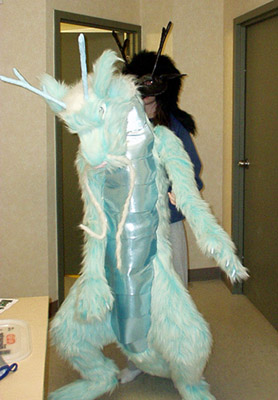
During March in 2003, I saw the stage musical version of The Lion King. The puppets and costumes were amazing, and the mechanics of them started giving me ideas. I decided to try making a body puppet using the mechanics of the Timon puppet from the musical. At the time, I had also watched Miyazaki's Spirited Away a few many times - that's how the idea for Nakatsu came to be. An oriental dragon's body shape suited the mechanics of the puppet rather well, so I went with it. His name was taken from a Japanese river.
The way the mechanics of the puppet work is really very simple. There is a handle out the back of each elbow, so the puppeteer can move the arms. The back of the puppet's feet are attached to the puppeteer's feet, so when the puppeteer walks, the puppet walks.
The concept of the costume/puppet was that Nakatsu was the focus point, and the puppeteer was his shadow (in the photo I'm only wearing the puppeteer's mask - the rest of the clothing was black when I went out). Not many seemed to grasp that part of the concept, but the puppet went over well. The five-foot tail (that you can't see in the photo) provided a lot of amusement to onlookers.
Construction took about three months. The simplified skeleton used for the arms is made of lengths of dowling lashed together. At the elbows and shoulders, the lengths of dowling were joined by small lengths of plastic tubing to allow flexibility. The form of the puppet was made by gluing together inch-thick upholstry foam, stuffed with polyester stuffing. The skin is mostly fake fur (probably the most beautiful, thick and soft fake fur I've come across!), with vinyl on the soles of the feet. The belly scales are fabric stetched over sheets of kid-craft "fun foam", glued in place. The claws on the hands and feet are Sculpey. The "whiskers" were fake fur covered wire, sewn in place. The mask was originally made from paper clay sculpted over oversized plastic slushie straws (the horns on the puppet were made the same way) and more "fun foam", then painted black. The mask's mane was also fake fur.